November 2025
Inside the Newsletter:
2025 Solutions | Water Efficiency Projects | Waste & Pollution Prevention Projects | Energy Saving Projects | Events
2025 Solutions for Minnesota Businesses!
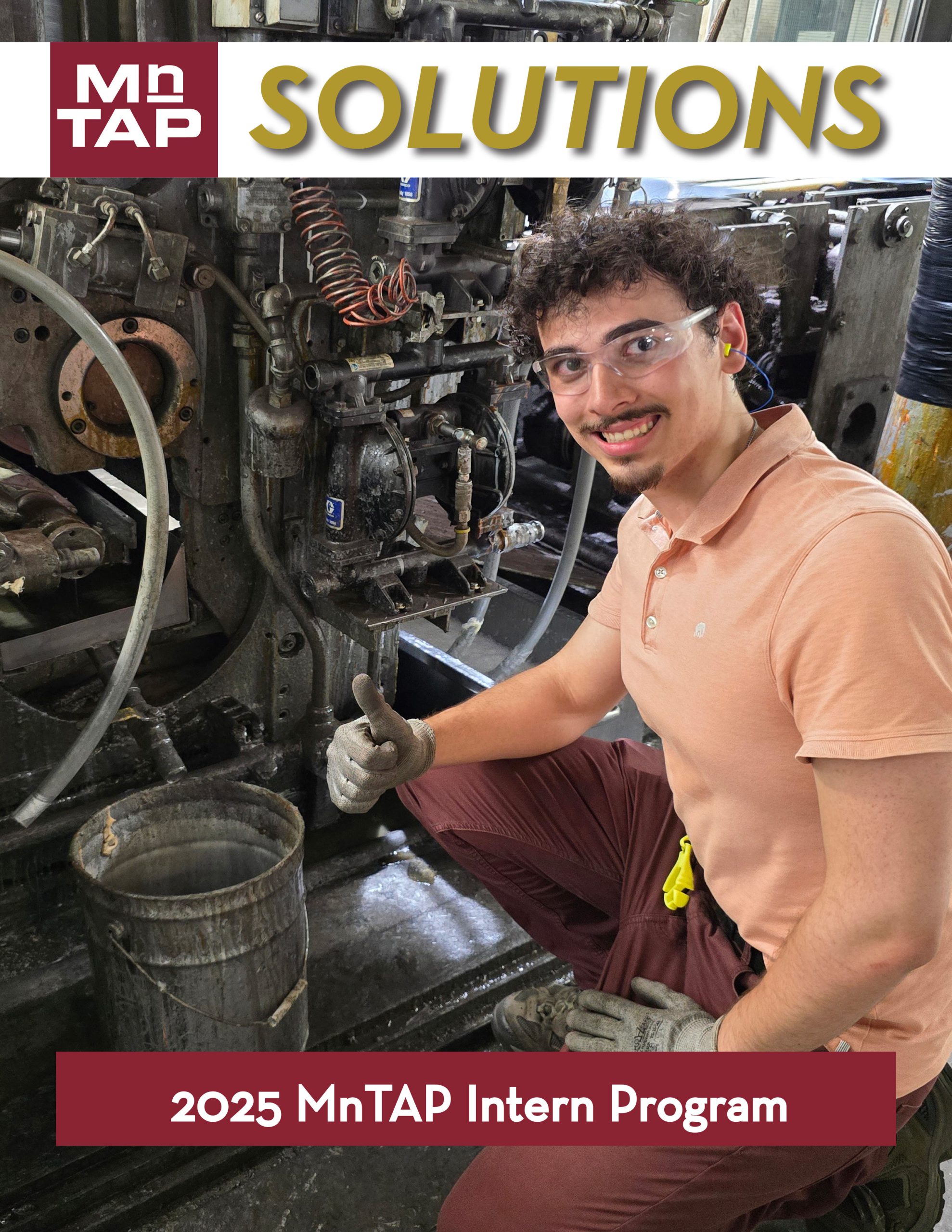
MnTAP is proud to announce the publication of the 2025 Solutions. This annual report highlights the results from our summer internship program. This year our group of 17 talented and industrious interns identified environmental reductions and process improvements that could save their companies:
- 141,000,000 gallons of water, saving $86,300
- 1,930,000 kWh electricity, saving $200,000
- 593,000 therms of energy, saving $357,000
- 1,800,000 pounds of solid and hazardous waste, saving $1,170,000
- 216,000 pounds of chemicals, saving $294,000
- 524,000 pounds of air emissions, saving $4,900
- As well as $307,800 in production impacts
Combined, these reductions have the potential to save companies $2,420,000 annually!
These results translate into real environmental impacts equivalent to:
- Eliminating CO2 emissions from more than 700 passenger vehicles and powering 200 Minnesota homes.
- Saving water equivalent to the water use for more than 6,000 Minnesota residents.
- Preventing the use of more than 430 55-gallon drums of chemicals.
We hope that as you read about the 2025 MnTAP intern projects and the results achieved, you will be inspired to contact MnTAP to learn how your company can benefit from having an intern at your site to maximize resource efficiency, increase energy efficiency, reduce costs, and prevent pollution.
Now is the Time to Apply for YOUR 2026 Intern!
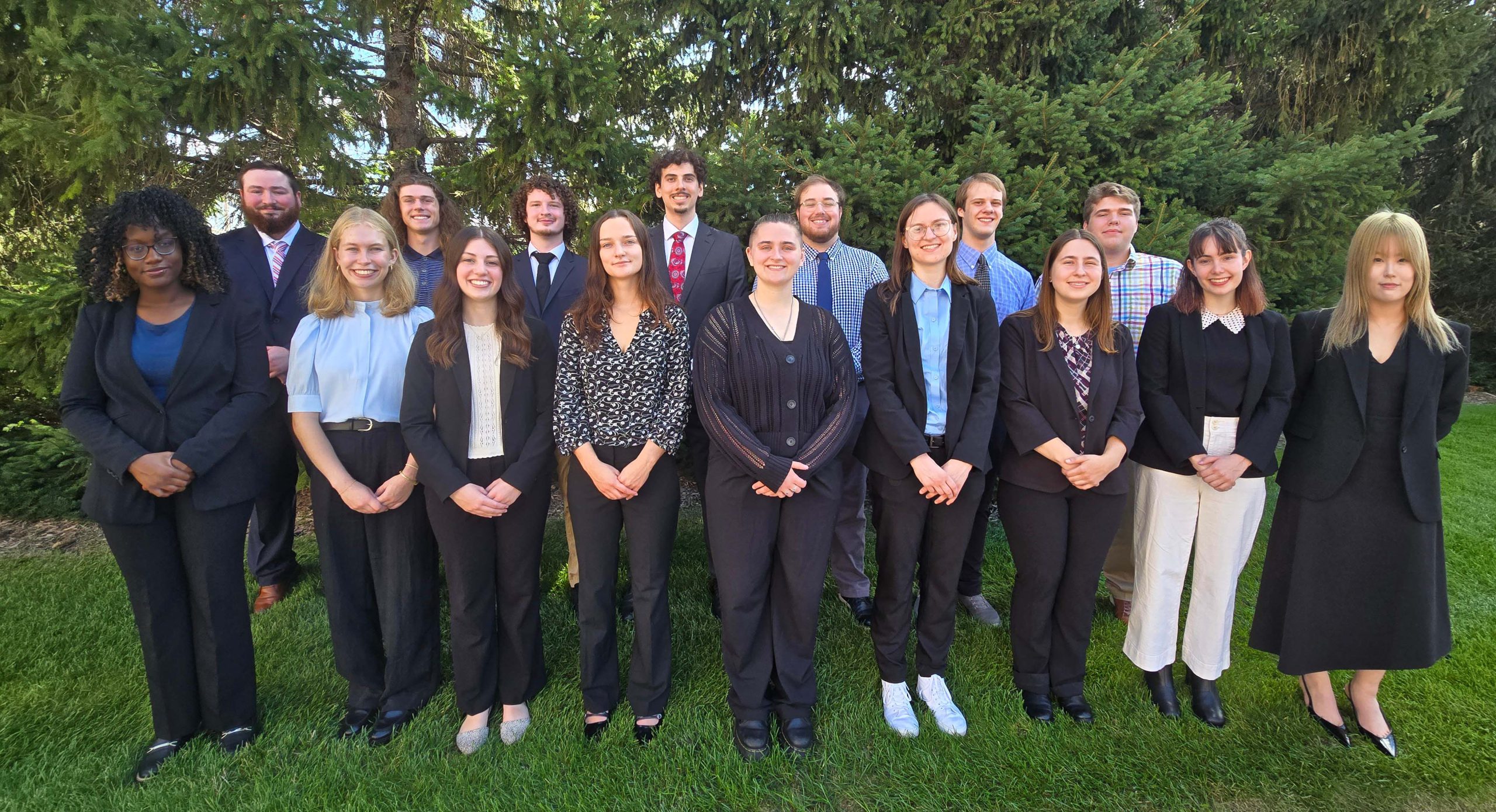 The MnTAP intern program pairs manufacturing, food processing, hospitality and other facilities in Minnesota with a college student who researches and recommends water conservation, energy efficiency and pollution prevention solutions. MnTAP interns have helped identify opportunities that save participating companies millions of dollars annually.
If your company could use another set of eyes to achieve similar results, now is the time to start thinking about developing a project for the summer of 2026. We anticipate supporting up to 15-17 projects that could focus on water conservation, energy efficiency, paint efficiency, solid waste, and pollution prevention.
Applications are currently being accepted and will be reviewed upon receipt. Companies will be contacted by MnTAP technical staff within two weeks for additional project development and scoping. Although applications are accepted through January 16th, 2026, companies are encouraged to apply by the end of 2025 to provide enough time to scope a well-defined project at their facilities.
For more information about the intern program or the application process, visit the MnTAP Intern Program webpages for Businesses. Use the Apply link to go directly to our project proposal form.
For More Information, Contact:
Matt Domski – Intern Program Manager
612-624-5119
mdomski@umn.edu
Water Efficiency Projects
The impacts of consuming water can add up quickly for companies, given that the true cost of water encompasses more than just paying for water supply. Processes such as purification, heating and cooling, as well as pumping and discharge pre-treatment can all have an impact on a company’s bottom line. With economic and environmental impacts in mind, 2025 interns identified ways to conserve more water by implementing process controls, upgrading to more efficient equipment, and modifying existing procedures.
Nina Mirfakhraie
Chemical Engineering, University of Minnesota Twin Cities
Beacon EmbeddedWorks (Beacon) manufactures custom System-on-Modules, or small computer boards used for processing, graphics, memory, and WiFi and Bluetooth connectivity. It has a 50,000 square-foot facility located at Eden Prairie, Minnesota. After working with a MnTAP intern this past summer, Beacon has planned or implemented solutions to reduce their industrial water use. Among water-saving recommendations, the MnTAP intern proposed enabling an automatic shutoff setting to promptly turn off water whenever boards were not on the conveyor belt, installing a rain sensor on their lawn irrigation system, and installing low-flow toilets and urinals during their upcoming bathroom renovation. Implementing all three solutions will collectively lead to saving 210,100 gallons of water, 12,720 kilowatt-hours (kWh), $2,845 a year.
Clare Heupel
Bioproducts & Biosystems Engineering – University of Minnesota Twin Cities
Bailey Nurseries is a family-owned, fifth-generation wholesale nursery with facilities located in Woodbury, Minnesota along with four other states. This MnTAP internship focused on reducing the 483 million gallons of water used per year over approximately 17 million square feet. The MnTAP intern proposed optimizing irrigation settings to meet the needs of various pot sizes, installing a wireless irrigation system to schedule and control valves wirelessly, programming booms with fan nozzles to prevent over spraying, and reevaluating irrigation guidelines. Evidence suggests watering 20% less would not adversely affect the plants’ health. Implementing all four solutions will collectively lead to saving 120,816,000 gallons of water, 398.5 labor hours, and $13,205 per year.
Waste & Pollution Prevention Projects
Waste streams can vary widely across industries, as can the approaches to identifying source reduction and diversion solutions. MnTAP Interns investigated ways to minimize a variety of waste and chemical sources through 2025 intern projects. Multiple interns explored opportunities to minimize production waste generation and chemical usage. MnTAP Interns also discovered opportunities to reduce and divert a variety of solid waste streams. Finally, interns quantified and recommended opportunities for reuse and repurposing of equipment and supplies. Minimizing waste and pollution is not only good for our communities and the environment, but it also has potential to save businesses money through reduced purchasing, processing and disposal costs.
Evin Corrigan
Chemical Engineering- University of Minnesota-Duluth
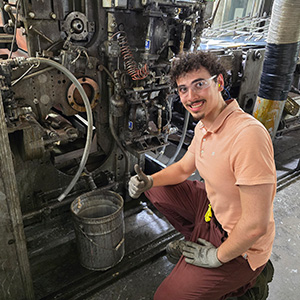
Silgan Containers is one of the largest suppliers of steel and aluminum food and non-food cans in North America and operates more than 20 manufacturing plants across the United States. Its facility at Savage, Minnesota reached out to MnTAP for assistance on how to reduce scrap rates and solvent use during its cleaning operations. Scrap disposal generates high disposal costs and can lead to facilities being classified as a Large Quantity Generator (LQG) due to their solvent use. The MnTAP intern proposed switching to a disposable blade system after identifying the scraper blade system, which is used to clean the chiller roller in the reusable blade system, as generating significant scrap waste and hazardous solvent use. Next, the MnTAP intern proposed increasing the use of a permanent wash basin during full deep cleanings when switching between enamel types to save E-30 solvent. Implementing both will collectively lead to saving over 48 tons of E-30, 64 tons of steel sheets, and $340,500 per year.
Fanuel Akakpo Ayewanou
Public Health – University of Iowa
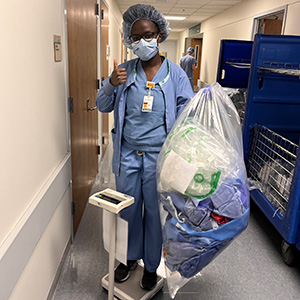
M Health Fairview is the state’s only university-affiliated academic medical center and is located in Minneapolis, Minnesota. M Health Fairview reached out to MnTAP for assistance in reducing the amount of medical waste its operating rooms generate. A MnTAP intern chose three common surgical operations as representative cases to propose resource optimization and waste management solutions. These solutions included exploring reusable alternatives for the over 4,100 pounds of gowns and drapes being disposed of annually and working with its current plastic recycling contractor to divert 65,4000 pounds of clean, non-contaminated plastics (e.g., irrigation bottles, trays, and medical packaging film) that are currently being discarded. Implementing both will collectively lead to reducing 69,500 pounds of waste and saving $3,300 per year.
Energy Efficiency Projects
Energy efficiency is a significant focus area for many MnTAP Interns. Projects can focus directly on energy assessments, where energy systems and equipment are investigated for potential improvements. Interns also find that energy savings can be embedded within the results of other types of recommendations, such as water conservation and process optimization solutions. Whether large or small, energy savings by MnTAP Interns often help financially justify process changes that are recommended for improved environmental performance.
Richard Bui
Aerospace – University of Minnesota-Twin Cities
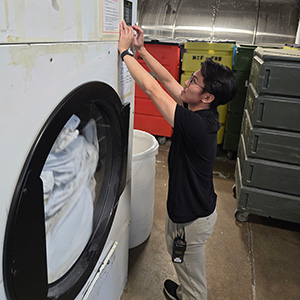
MINNCOR Industries is a collection of unified facility operations for the MN Department of Corrections, which exists for the primary purpose of providing job skill training, meaningful employment, and teaching proper work habits to Incarcerated Persons (IPs). MINNCOR connected with MnTAP to address opportunities for improvement at its industrial laundry operations in Faribault, Minnesota. A MnTAP Intern analyzed the steam condensate recovery system, as well as the efficiency of existing laundry equipment. In terms of laundry equipment, it was found that installing exhaust sensors and programming automatic dryer settings could save a total of 8,500 therms of natural gas and 6,000 kWh of electricity annually. Implementation of these solutions is underway, which will save $7,400 annually.
Ben Davis
Bioproducts & Biosystems Engineering – University of Minnesota-Twin Cities
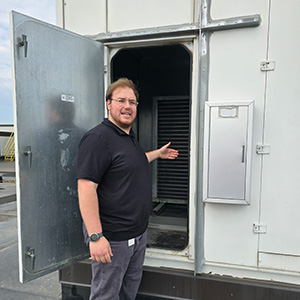
The Aveda Corporation (Aveda), a branch of the Estée Lauder Companies Inc., is a cosmetics company that produces hair and skin care products. The team at Aveda’s facility in Blaine, Minnesota, partnered with MnTAP to explore energy efficiency opportunities within its production and office spaces. A MnTAP Intern studied staff occupancy trends and used that data to recommend optimized HVAC schedules which would reduce time running fans and cycling compressors. In production areas, the intern found opportunities to reduce HVAC system operation during non-operating hours, as well. By implementing these solutions for both office spaces and production areas, Aveda can save 263,700 kWh of electricity,6,990 therms of natural gas and $36,450 per year.
Events
Unlocking Energy Savings: Technical Assistance for Minnesota’s Large Energy Users
US Department of Energy, MnTAP, & Minnesota Department of Commerce
November 19, 2025, 11:00AM – 12:00PM
Virtual, No Cost
Large energy users—especially in the industrial sector—have access to valuable no-cost technical and financial resources, yet many facilities remain unaware of these opportunities. This webinar will provide an overview of available state and federal programs and guide you through the process of accessing expert support for your facility. Whether you operate a manufacturing plant, processing facility, wastewater plant, or other energy-intensive operation, this session will connect you with the resources and expertise needed to identify cost-saving opportunities and implement sustainable energy solutions.